The honest answer: a glass shop front costs between £2,500 and £12,000+ fitted
That range is wide for a reason. A basic aluminium-framed glass shop front for a small retail unit is a fundamentally different product from a bespoke frameless glass installation on a 6-metre commercial frontage. Both are “glass shop fronts.” Neither should be priced using the same number.
What this guide does: gives you the real breakdown by material, size, and feature — so you can walk into any conversation with a fitter knowing exactly what’s driving the quote, and exactly where to push back.
Quick Price Reference: UK Glass Shop Front Costs 2026
| Type | Cost Per m² | Small Unit (7.5m²) | Medium Unit (12m²) | Large Unit (21m²) |
|---|---|---|---|---|
| Aluminium shop front | £350–£450/m² | £2,625–£3,375 | £4,200–£5,400 | £7,350–£9,450 |
| Toughened glass shopfront | £450–£550/m² | £3,375–£4,125 | £5,400–£6,600 | £9,450–£11,550 |
| Frameless glass shopfront | £500–£700/m² | £3,750–£5,250 | £6,000–£8,400 | £10,500–£14,700 |
| Timber shopfront | £500–£650/m² | £3,750–£4,875 | £6,000–£7,800 | £10,500–£13,650 |
All prices include professional installation and VAT. Survey and site-specific access costs may vary.
What Actually Drives the Price
1. Frame Material — the single biggest variable
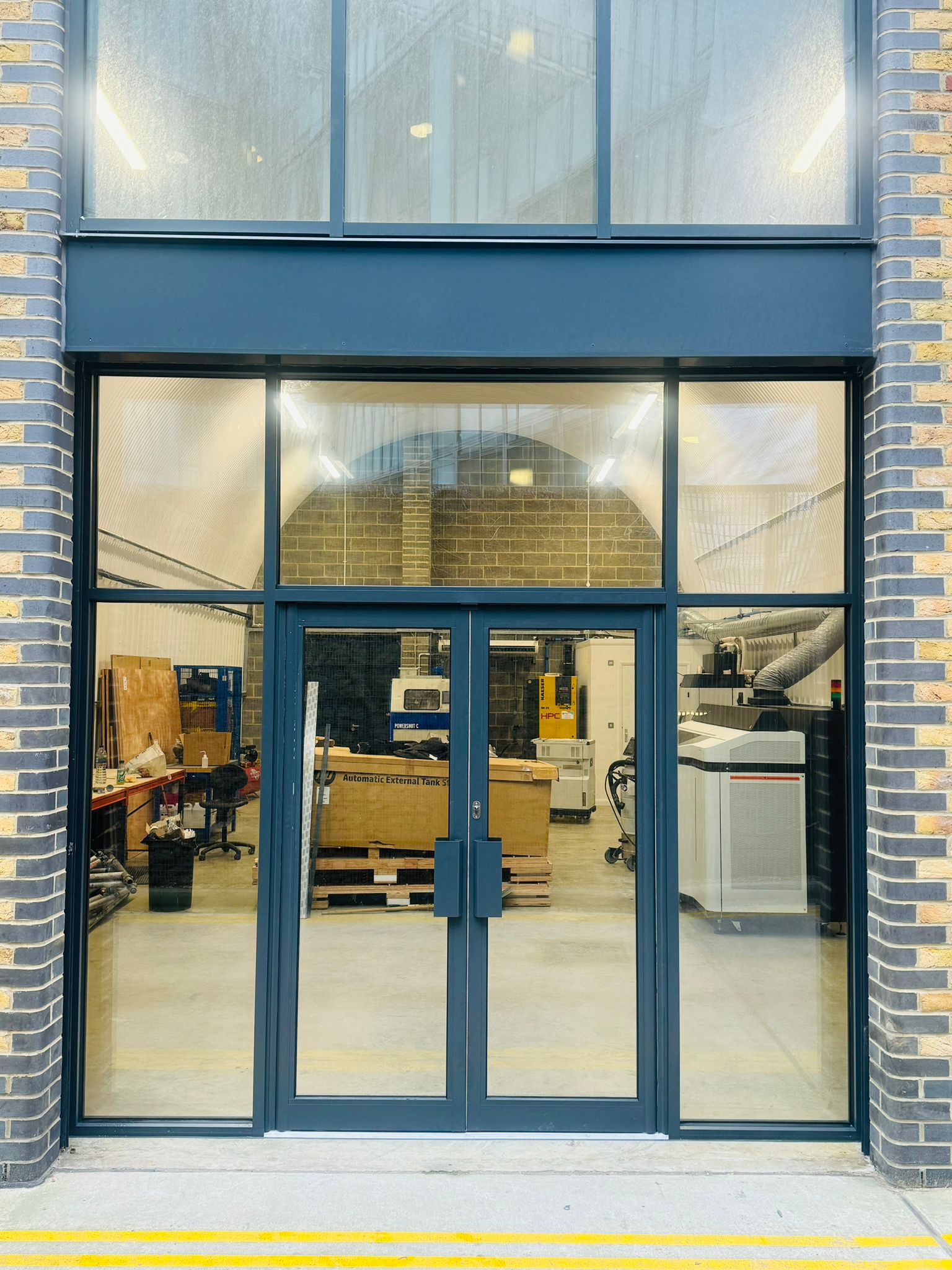
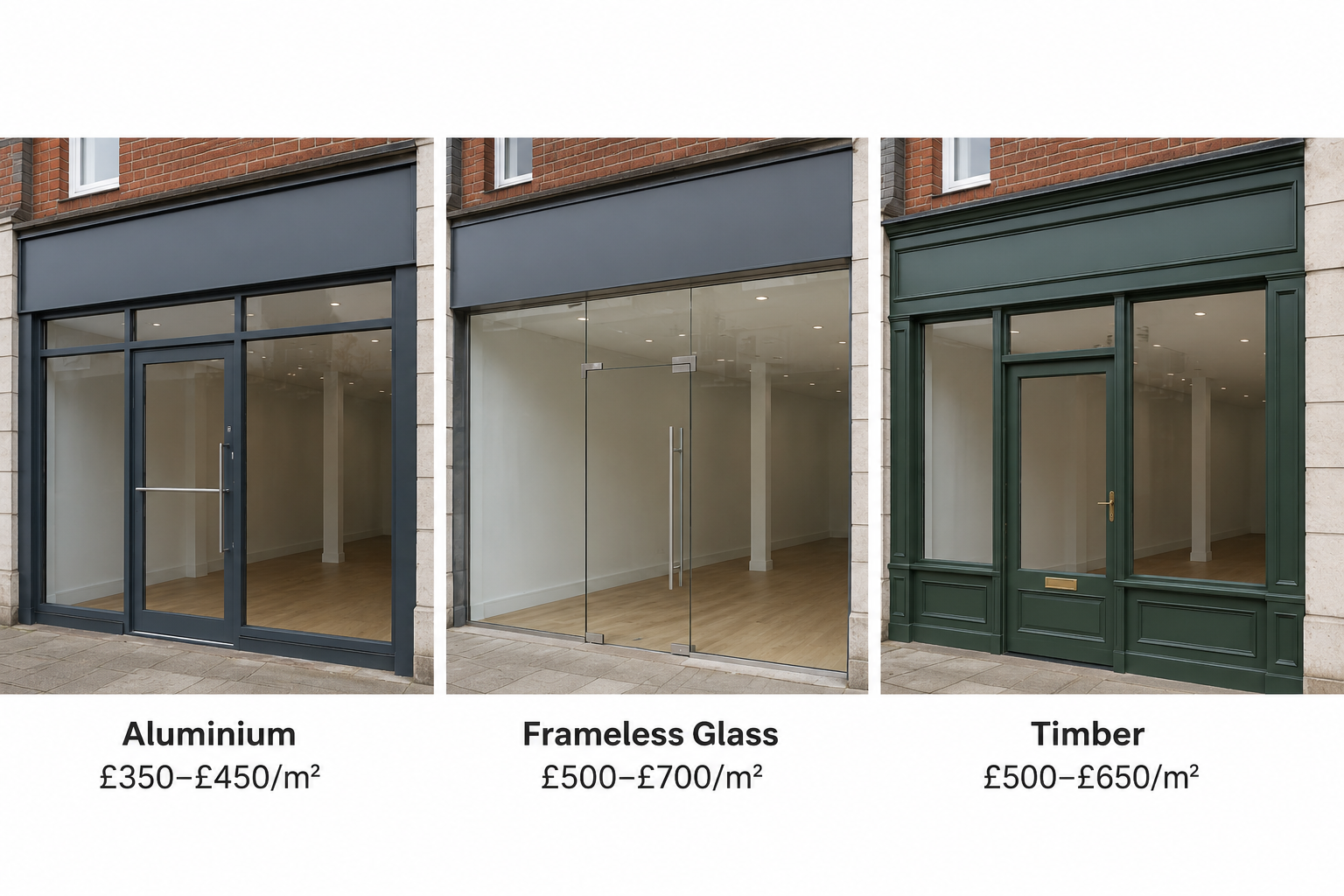
Aluminium shop fronts are the most popular choice for UK commercial properties, and for good reason. Aluminium is lightweight, weather-resistant, and doesn’t corrode. Powder-coated finishes come in any RAL colour, so you’re not stuck with silver or white. Expect to pay £350–£450 per square metre fitted.
The downside: cheaper aluminium systems use thin-wall extrusions that can flex under impact. Always ask for the wall thickness specification before agreeing to a quote.
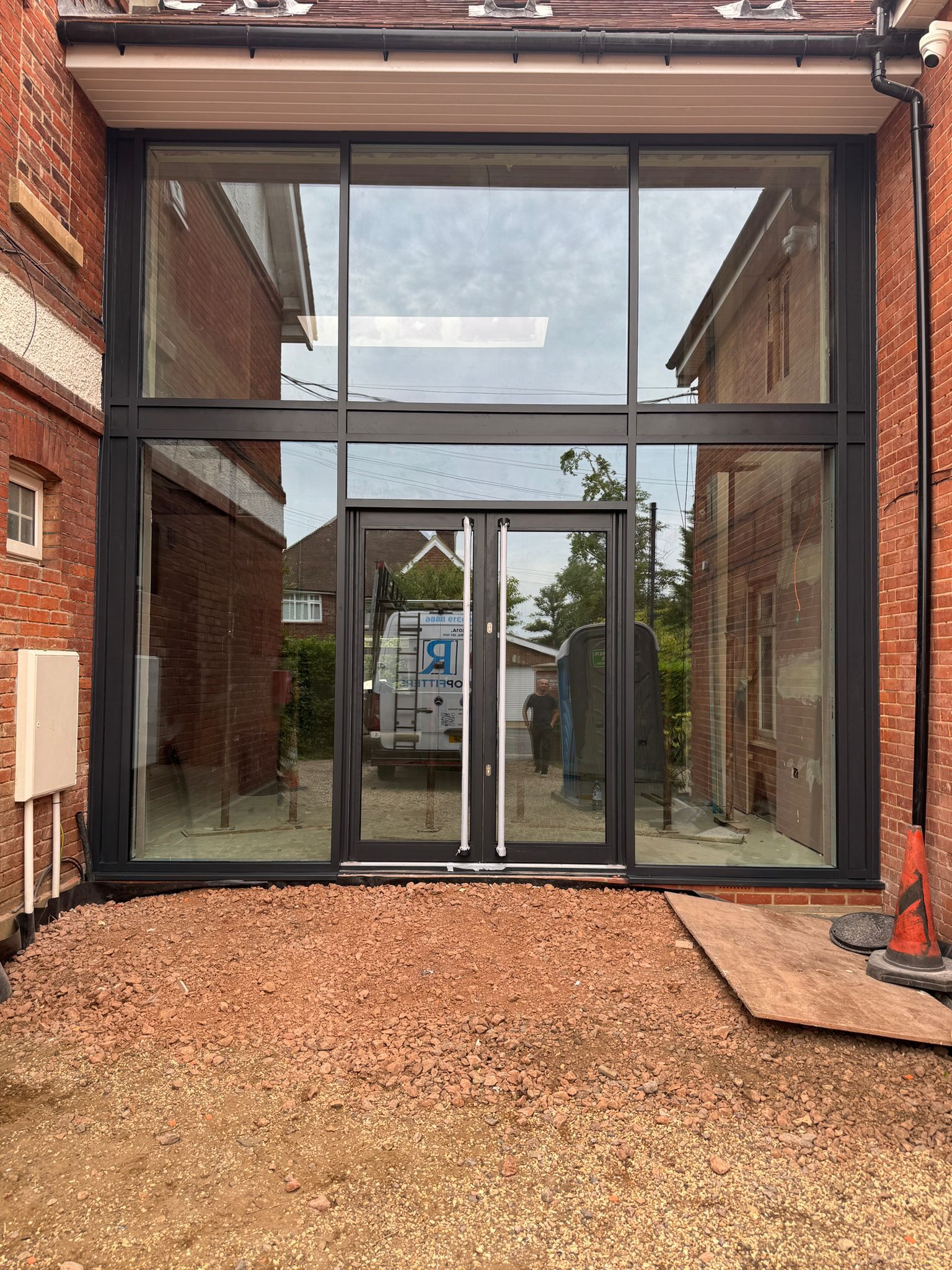
Frameless glass shop fronts remove the visible aluminium frame entirely, giving you maximum visual impact and the cleanest possible window display. They rely on structural adhesive, patch fittings, or top-hung rail systems to support the glass — all of which add cost. Budget £500–£700 per square metre fitted, and expect a longer lead time for bespoke fabrication.
Timber shopfronts suit conservation areas and listed buildings where modern profiles look out of place. They’re more expensive to maintain — painting every 3–5 years — and are rarely used for large commercial frontages. Cost: £500–£650 per square metre fitted.
2. Glass Type — affects both price and performance
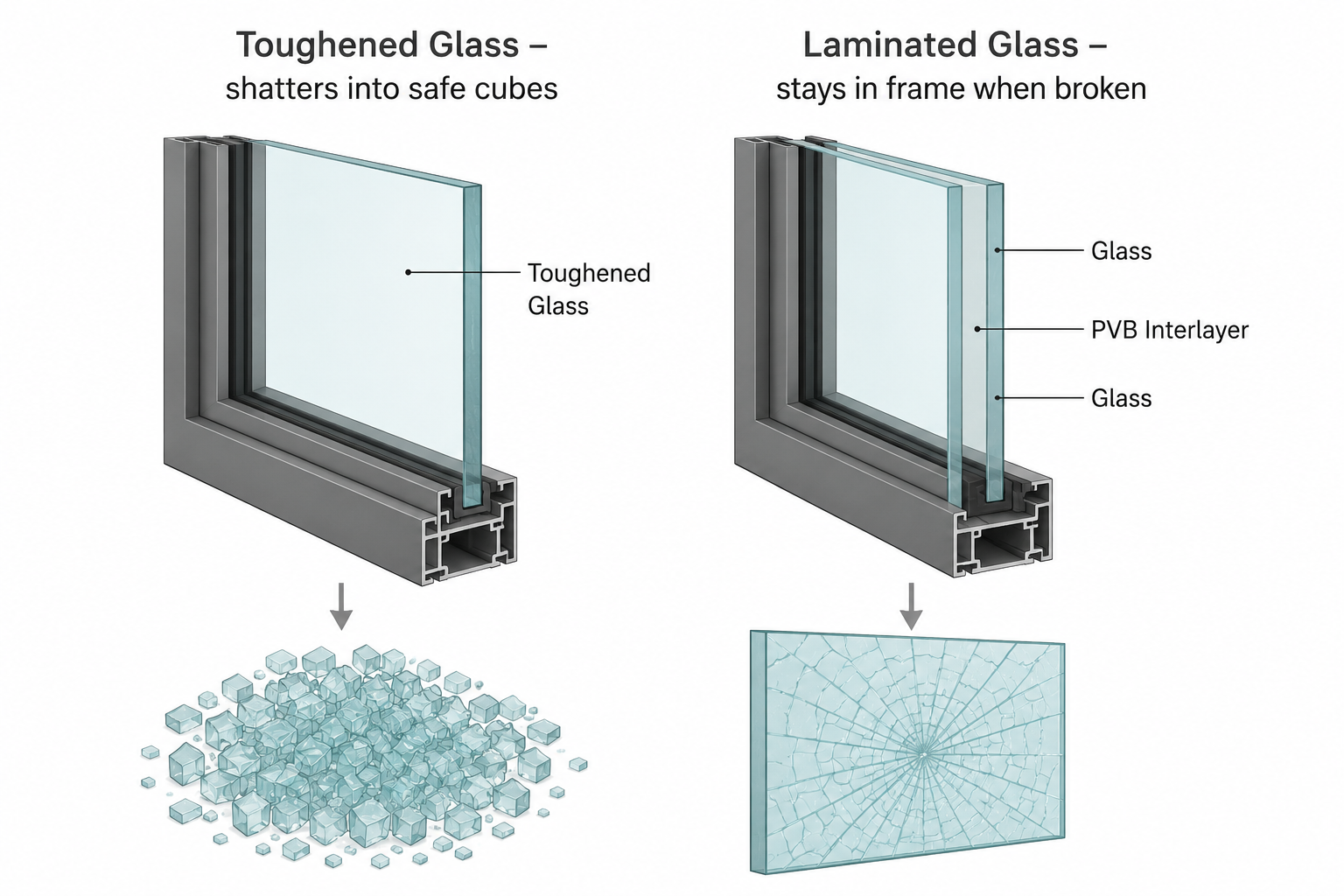
Toughened glass is the standard for commercial shop fronts. It’s heat-treated to be 4–5x stronger than standard float glass, and it fractures into small blunt cubes rather than dangerous shards. It’s what’s specified in most Building Regulations-compliant installations. Cost uplift over basic glass: 20–30%.
Laminated glass adds a polyvinyl butyral (PVB) interlayer between two panes. If it breaks, the glass stays in the frame rather than falling. This matters for security — a broken laminated pane is still a barrier; a broken toughened pane is an open hole. Expect to pay 15–25% more than equivalent toughened glass. High-risk areas, high-value retail, or premises with insurance requirements often specify laminated.
Double-glazed units (toughened both sides, argon-filled cavity) cost the most but deliver genuine thermal and acoustic performance. They make sense for hospitality venues or offices where climate control costs are significant.
One thing competitors won’t tell you: most quoted prices default to toughened single-glazed units. If you want laminated or double-glazed, ask specifically — it’s not always included in a “glass shop front” quote.
3. Size and Frontage Complexity
Cost per square metre only tells part of the story. A 3m x 2.5m rectangular frontage is straightforward. A 6m frontage with a recessed entrance, two separate door positions, and a stepped floor threshold is three times the complexity at more than twice the cost.
Factors that push the price up:
- Non-standard or bespoke panel sizes (custom glass cuts cost more than standard stock sizes)
- Angled or curved glass (significant premium — get a specific quote)
- Multi-section frontages with internal pillars or structural constraints
- Restricted access (busy high streets, narrow pavements, upper-floor work)
- Removal and disposal of an existing shopfront (add £300–£800 depending on size and materials)
4. Shopfront Doors
The door is usually the most-used — and most failure-prone — component of any shopfront. Don’t let a fitter underspecify it.
Aluminium shop front doors (manual, single or double): £800–£1,500 fitted. This is your standard hinged or pivot door in a matching aluminium frame. Specify commercial-grade closers rated for high-frequency use (minimum EN 2 or EN 3 for retail).
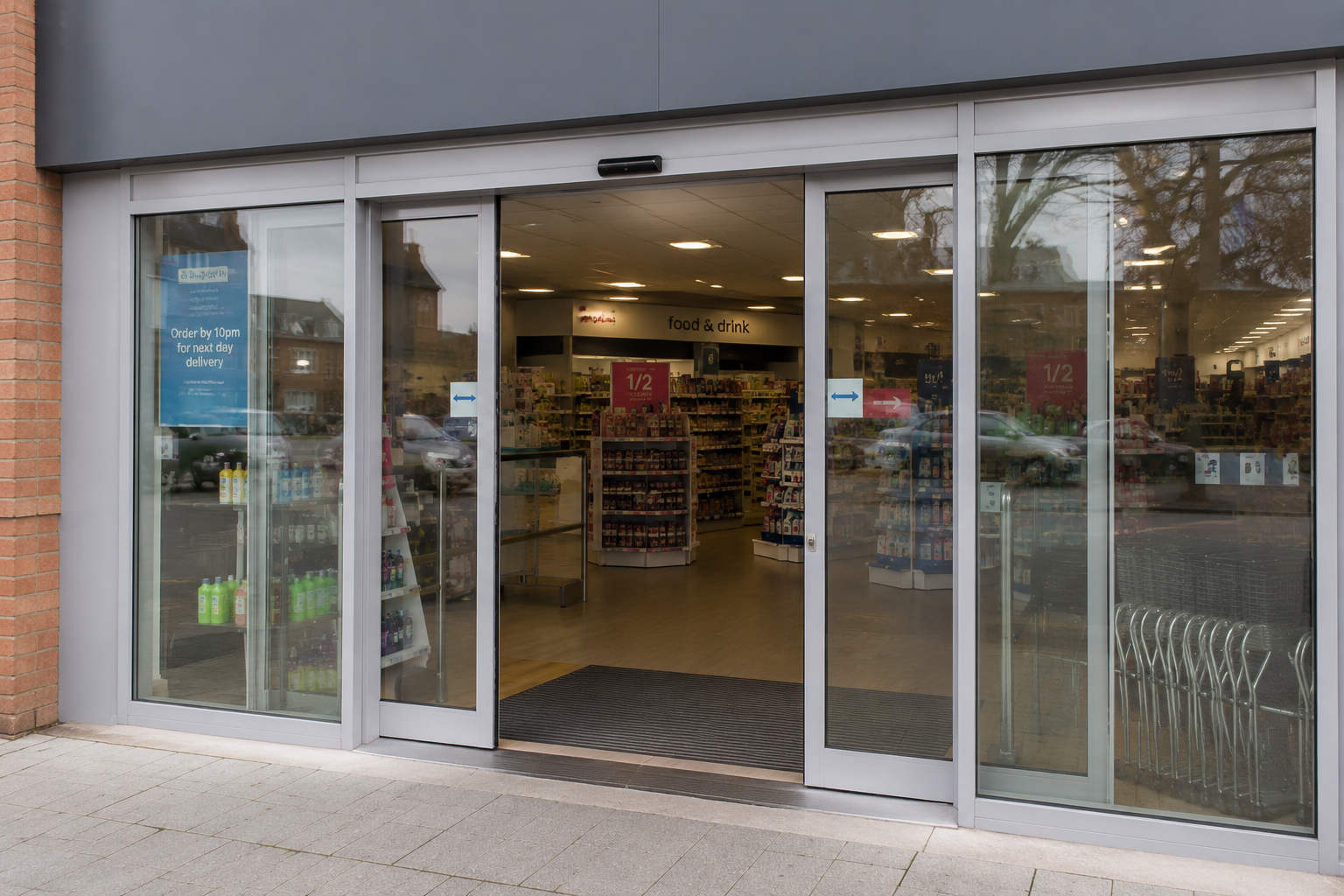
Automatic sliding doors: £2,000–£4,500 fitted depending on leaf width and drive mechanism. Bi-parting systems cost more than single-leaf. Always check whether the quote includes a manual override for power failure — a legal requirement in most occupancies.
Automatic swing doors: £2,500–£5,000. Often specified for accessibility compliance (DDA/Equality Act). If your premises serves the public, consider whether you have an obligation here regardless of cost preference.
5. Shop Front Shutters
Shutters are a security layer, not an afterthought. And the difference between a cheap and a quality shutter becomes obvious within 18 months.
| Shutter Type | Cost Per m² | Notes |
|---|---|---|
| Manual roller shutter | £150–£200/m² | Budget option; can look dated |
| Electric roller shutter | £250–£320/m² | Most popular for commercial |
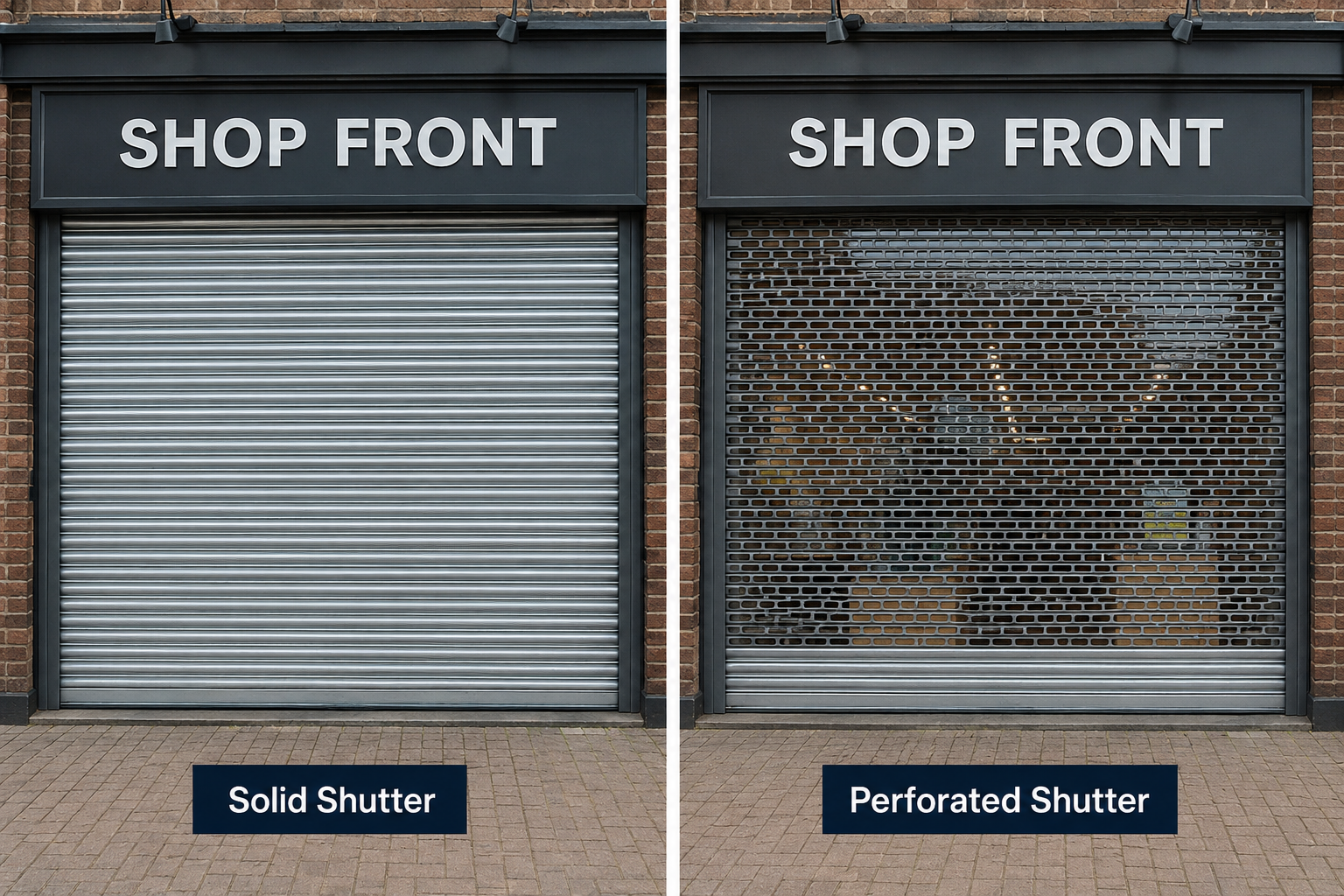
| Perforated roller shutter | £200–£260/m² | Deters vandalism while allowing visibility |
| Fire-rated roller shutter | £300–£400/m² | Required in some commercial settings |
| Solid steel security shutter | £200–£280/m² | High-security retail or cash businesses |
Shop front shutters near you: R Shopfitters installs and services shutters across the UK. Supply-and-fit is almost always better value than buying the shutter yourself and paying a third party to install it — the fixing points need to be coordinated with the shopfront frame at installation stage.
6. Location and Access
Labour costs vary by region. London and South East installers charge 20–35% more than equivalent firms in the North or Midlands. That’s not profiteering — it reflects vehicle costs, parking, congestion charges, and local wage rates.
Access matters too. A ground-floor frontage on a quiet side street is far easier to work on than a busy high street unit where you need traffic management, scaffolding, or out-of-hours installation. Out-of-hours work (evenings, weekends) typically adds 15–25% to labour costs — but often makes sense to avoid disrupting trading.
Additional Features and Their Typical Costs
| Feature | Typical Cost | Worth It? |
|---|---|---|
| Integrated LED lighting (canopy/cill) | £150–£600 | Yes — drives evening footfall |
| Company signage tray/cassette | £300–£1,500 | Yes if you don’t have separate signage |
| Smart locks / access control | £200–£800 | Yes for multi-tenant or out-of-hours access |
| Frosted or manifestation film | £100–£350 | Yes for privacy or branding |
| Security film (glass retention) | £80–£200 | Consider for high-risk areas |
| Thermal break profiles (energy efficiency) | +£200–£500 | Yes if heating bills are significant |
Aluminium vs Frameless Glass: Which Is Right for You?
Choose an aluminium shop front if:
- You want the best value for money over a 10–15 year lifespan
- Your frontage is large (less glass movement risk with frame support)
- You’re in a windy or coastal location (frames provide better edge protection)
- You need an integrated shutter or roller grille
- Budget is a constraint
Choose a frameless glass shopfront if:
- Visual impact and window display are commercial priorities
- You’re in high-footfall retail, fashion, jewellery, or hospitality
- Your neighbours have aluminium fronts and you want to stand out
- You’re willing to pay for maintenance (frameless seals need more frequent inspection)
- The build quality of your structural opening is good (frameless systems are less forgiving of movement)
Shop Front Design Considerations
The design of your shopfront isn’t just aesthetic — it affects planning consent, footfall conversion, and long-term maintenance costs.
What planning says: Most shop front changes in England require planning permission, especially in conservation areas, Article 4 direction areas, or on listed buildings. Don’t assume permitted development applies. Your installer should know the local planning position before they start — if they don’t ask about it, that’s a warning sign.
What design does for conversion: Research consistently shows that shopfront design affects whether passers-by enter. Clear glass, strong lighting, and unobstructed sightlines into the space increase dwell and entry rate. A cluttered or poorly lit front does the opposite. The shopfront is your most visible marketing asset.
Pharmacy shop front design: Pharmacies have specific considerations — accessibility requirements (level threshold, wide automatic doors), NHS branding guidelines, and often listed building or conservation area constraints in older town centres. R Shopfitters has worked with pharmacy operators nationally and understands these requirements.
How to Get an Accurate Quote (and Not Get Caught Out)
What to prepare before calling a fitter:
- The width and height of your opening (measure at multiple points — they’re rarely perfectly square)
- Photographs of the existing frontage and the building above it
- The address and postcode (so they can check planning constraints before visiting)
- Whether you have an existing shopfront to remove
- Whether you need a shutter, automatic door, or any security upgrade
- Your preferred completion date and whether out-of-hours installation is viable
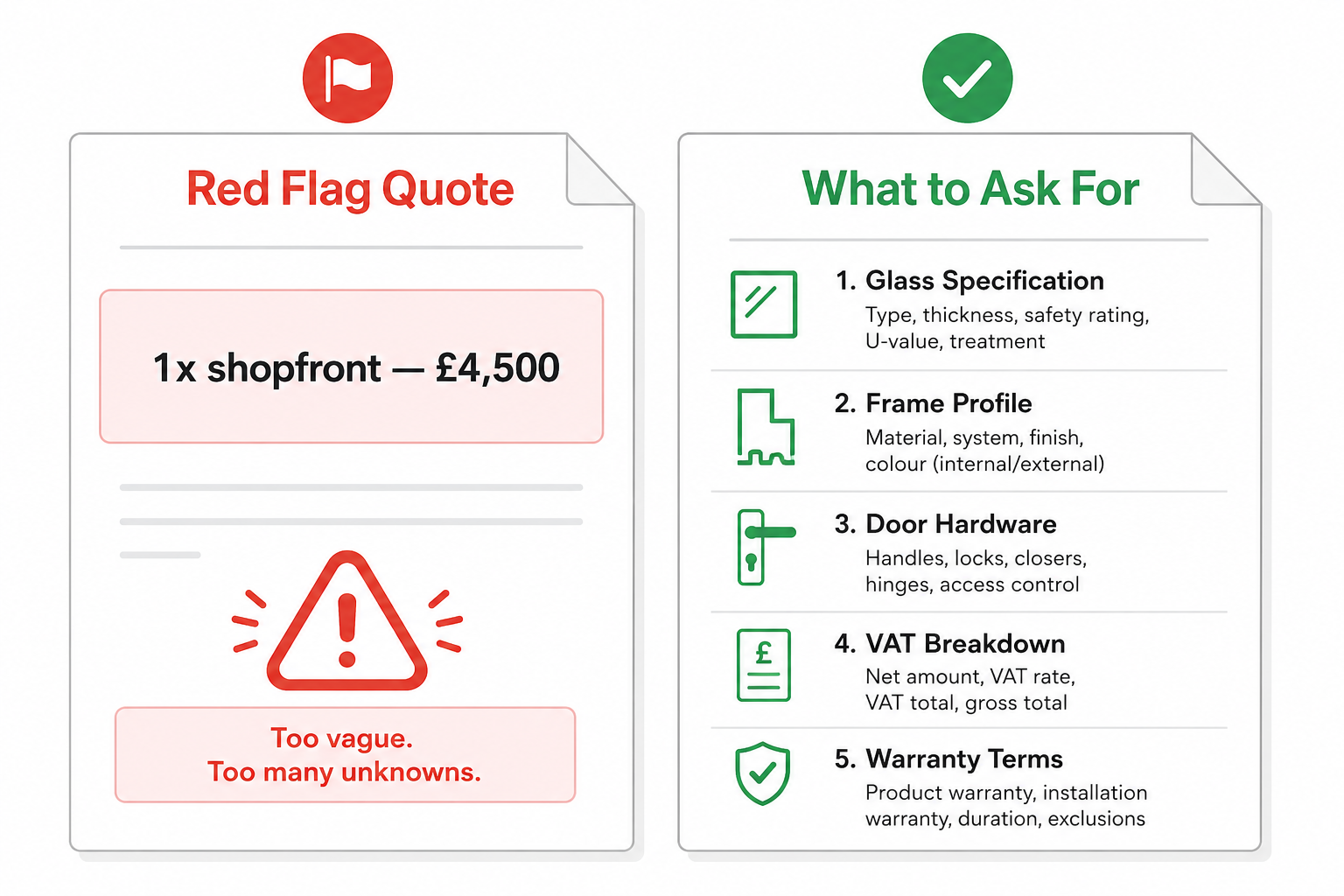
What a good quote should include:
- Glass specification (toughened/laminated, thickness, coating)
- Frame profile specification (manufacturer, series, wall thickness)
- Door hardware grade and manufacturer
- Removal and disposal of existing frontage (or explicitly state it’s excluded)
- VAT — always ask whether prices are ex-VAT or inclusive
- Timeline from survey to installation
- Warranty terms — separately for materials and for workmanship
Red flags in a shopfront quote:
- No site survey before quoting (guessing dimensions from a photo isn’t professional)
- A single lump-sum price with no breakdown
- No mention of planning — some fitters will install and leave you to deal with enforcement
- Warranty that covers “materials only” — this excludes the installation, which is where most problems occur
What Does a 1-Day Installation Actually Mean?
It’s a genuine selling point when a fitter says they can install a standard shopfront in one day — but it comes with assumptions:
- The structural opening is sound (no remedial masonry needed)
- The existing frontage, if any, comes out cleanly
- Bespoke glass panels were pre-measured and fabricated (which requires a prior survey visit)
- Access is available from early morning
A 1-day install is realistic for standard aluminium-framed glass shop fronts on straightforward openings. Frameless systems, large multi-section frontages, or buildings requiring additional prep work will typically take 2–3 days.
R Shopfitters completes most standard installations in a single day — but we’ll tell you before we start if yours will take longer. We won’t promise something we can’t deliver.
Glass Shop Front Cost FAQ
How much does a basic glass shopfront cost in the UK?
For a small-to-medium retail unit (7.5–12m²), expect to pay £2,500–£5,400 for an aluminium-framed glass shopfront fully installed. Frameless glass systems start around £3,750 for the same size.
How much do automatic shopfront doors cost?
Automatic sliding doors cost £2,000–£4,500 fitted. Automatic swing doors cost £2,500–£5,000. Manual aluminium shop front doors cost £800–£1,500.
Is toughened glass worth the extra cost for a shop front?
Yes — and in most cases it’s not optional. Building Regulations require safety glass in critical locations, and toughened glass is the standard compliant specification. Laminated glass costs more but offers better security (it stays in the frame when broken).
Do I need planning permission for a new shop front?
Usually yes in conservation areas and always for listed buildings. In other areas, it depends on the extent of the change. R Shopfitters advises on planning requirements as part of every survey — don’t assume you don’t need consent.
How long does a glass shopfront last?
A well-specified, properly installed aluminium shopfront should last 15–25 years with routine maintenance. Frameless systems require more frequent seal inspection (every 3–5 years). Cheap frames with thin-wall profiles or inadequate surface treatment will fail sooner.
What’s the difference between a glass shop front and a frameless shop front?
An aluminium-framed glass shopfront has visible structural aluminium profiles holding the glass. A frameless shopfront uses minimal or concealed fixings so the glass is the dominant visual element. Frameless costs more and offers more visual impact; framed is more robust and better value.
Get a Fixed-Price Quote for Your Shopfront
R Shopfitters provides free site surveys and fixed quotations across the UK. No estimates, no hidden extras — the price you’re quoted is the price you pay.
What’s included in every installation:
- Free site survey with planning advice
- Fixed written quotation with full specification
- Professional installation by our own employed team (not subcontracted)
- 12-month workmanship guarantee
- Manufacturer warranties on all glass and hardware
Call 07903 198 886 or email info@rshopfitters.co.uk to book your free survey.
R Shopfitters — aluminium shopfronts, glass shop fronts, frameless glass, automatic doors, and shop front shutters installed across the UK.